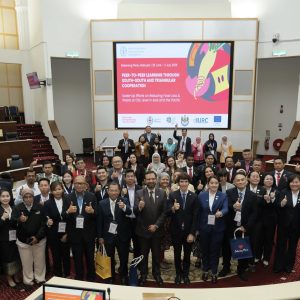
The session Ensuring lasting impact for Food Policies in Africa, held on October 15th as part of the MUFPP Global Forum 2025, addresses a question that is crucial for anyone working on food policies: what strategies have proven most effective in transforming the short-term outcomes of 3–4-year projects into lasting policy frameworks or institutional practices?
AfriFOODlinks project partners – ACRA and ESTà, invited five cities – four African (Chefchaouen, Dakar, Mbale, and Ouagadougou) and one European (Grenoble Alpes Metropole) – to take part in the discussion on how they are organising to move from practices to policies.
AfriFOODlinks is an EU Horizon project led by ICLEI Africa, involving 15 African cities and 5 European cities, and 28 partners. The project combines research and innovation with the implementation of scalable actions. Since its day one, AfriFOODlinks has sought to support cities in applying project lessons by fostering resilient, adaptable social and institutional structures.
The session was introduced by Bianca Minotti (ESTà) and Valerio Colosio (ACRA).
The most effective strategies for transforming short-term projects into lasting food policies
Below, the contributions from the participating cities highlighted concrete experiences and lessons learned, followed by an intervention from Luke Metelerkamp (Head of African City Food Centre at ICLEI Africa and AfriFOODlinks project coordinator) outlining the project’s long-term strategy.
Chefchaouen, Morocco
Abderrahmane Darghali described Chefchaouen’s Mediterranean Diet strategy, recognized by UNESCO. It revolves around four axes: heritage preservation, local capacity building, awareness and communication, good governance. Tools such as the Mediterranean Diet House and a local quality label engage citizens, especially youth and women, ensuring inclusive and sustainable food governance.
Dakar, Senegal
Mohamed Ben Ndoye explained how the challenges of urbanization and climate change influence the making of responsive strategies in Dakar. Local Development Centers (CDLs) train communities, while partnerships, such as AfriFOODlinks, support urban agriculture, school canteens, and food governance frameworks.
Mbale, Uganda
Namubiru Halima described how two levels of governance – food councils and parliaments – unite vendors, policymakers, and citizens to address food safety and embed governance into city structures.
Ouagadougou, Burkina Faso
Wahab Kiendrebeogo emphasized co-construction efforts in revitalizing the green belt. By involving communities, street-food vendors, and market federations, the city achieved long-term ownership and policy continuity, integrating projects into the broader territorial food strategy.
Grenoble Alpes Métropole
Léa Ravinet highlighted Grenoble’s Interterritorial Food Project engaging 49 municipalities. With EU and national support, the city co-constructed a shared vision through scientific studies, stakeholder dialogue, and formalization of strategies, and communication within existing structures.
Luke Metelerkamp, AfriFOODlinks project coordinator, explained AfriFOODlinks’ strategy to ensure long-term impact of the project by connecting city-level efforts to national, regional, and continental processes. Looking ahead, the project plans to sustain these relationships over the next ten years. Through a Theory of Change, AfriFOODlinks plan to grow the network to 60 African cities, creating concrete examples that can inspire and be replicated beyond the project’s lifetime.
In conclusion, during the session Ensuring lasting impact for Food Policies in Africa, it emerged that transforming short-term projects into lasting food policies requires cities to invest in governance, co-construction, and active stakeholders engagement. The experiences shared reaffirmed that embedding food governance within institutions, communities, and territorial visions is essential to ensure that today’s projects become tomorrow’s policies.


Special thanks to Martina Dell’Aquila, Mufpp Intern from the University of Milan, for writing this article.