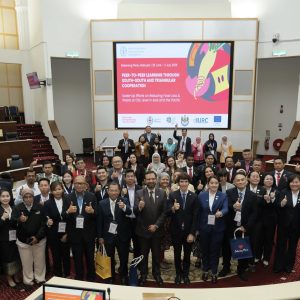
The session “Agroecology-based food systems in municipal policies: lessons from the Global South” took place during the MUFPP Global Forum 2025, held on 15 October 2025 at the University of Milan.
Organized by the Agroecology Fund, the session brought together experts and city representatives from the Global South to explore how municipalities are advancing agroecology to build more sustainable, resilient food systems. The discussion highlighted the critical role of local governments in integrating agroecology into urban policies to promote biodiversity, food security, and sustainable agricultural practices.
Introducing the session, the moderator, Angela Cordeiro, Co-Director of the Agroecology Fund, highlighted the central role of the Agroecology Fund as a key supporter of grassroots initiatives, backed by more than 50 funders since its establishment in 2012. Beyond grant-making, the Fund fosters cross-learning and evidence-building, notably through initiatives such as Grassroots Evidence for Agroecology, which supports organizations in documenting their impacts.
Case studies from cities
During the session, municipalities of the Global South shared their experiences and strategies to integrate agroecological principles into their food systems.
Muna, Mexico, presented how the municipal government supports the Mayan Milpa system, preserving biodiversity, soil health, and cultural traditions.
Carlos Baltazar Ayuso Vera, Mayor of Munajukatang and President of the Junta Intermunicipal Biocultural del Puuc – JIBIOPUUC, explained that this alliance of eight municipalities in Yucatán promotes sustainable rural development while respecting Mayan biocultural heritage. The Puuc region is one of Yucatán’s most biodiverse areas, where the Maya Milpa remains the heart of rural and cultural life. Corn, beans, squash, and other species grow together, fulfilling ecological roles and supporting biodiversity without agrochemicals or monocultures.
Minneth Medina, Director of JIBIOPUUC, noted that although the region produces the largest amount of fresh food in Yucatán, it faces pressures from industrial agriculture and deforestation. Inter-municipal collaboration has enabled initiatives to develop technical capacity, reorganize and finance traditional farming, and integrate sustainable practices into local development plans. The Milpa was officially recognized in 2022 by the FAO as a Globally Important Agricultural Heritage System (GIAHS). Over 1,400 community-based agricultural ventures have been supported, including participatory guarantee systems and educational programs on healthy meals.
Through these efforts, the Milpa not only ensures sustainable agriculture and food security but also strengthens local economies, fosters climate resilience, and promotes dignity, autonomy, and respect for the land.


Cabaiguan, Cuba, highlighted the importance of participatory governance in local food policies, actively involving communities in decision-making.
Aleida Yanes, Municipal Coordinator in Cabaiguan and representative of the Ministry of Environment, explained how Cuba’s transition to agroecology has been strengthened by a favorable national political and legal framework. This includes the Law on food sovereignty and food security (2022), a decree on municipal decision-making, and more recently the agroecology law, which provides incentives for implementing agroecological practices.
The discussion was further enriched by Margarita Fernández, Executive Director of the Caribbean Agroecology Institute, who presented the IPA-LAC project, a participatory action research initiative funded by the Agroecology Fund, that in Cabaiguan led to the creation of a municipal agroecology collective involving 40 actors from agriculture, education, health, farming communities, and local government. With support from the initiative, the municipality developed a methodology that not only helps evaluate the transition to agroecology but also builds capacity and identifies next steps toward achieving the desired transition.
Murang’a County, Kenya, shared its experience as a subnational government advancing an inclusive transition toward agroecology and sustainable food systems. Daniel Gitahi, Director of Agricultural Value Chains, Policy and Strategy at the Murang’a County Government, explained how declining productivity, soil degradation, water pollution risks, and biodiversity loss pushed the county to adopt a new agricultural vision.
The county introduced a food system transformation policy, committing 10% of government funding to agriculture, while recognizing the need to mobilize additional resources beyond public finance. Murang’a therefore developed an inclusive financing model, engaging producer organizations, universities, civil society, financial institutions, and international partners— including the Agroecology Fund—within structured multistakeholder platforms, and that operates to bring innovations through thematic working groups.
A central pillar of the transition has been capacity building, addressed through partnerships with universities that provide short-term training for farmers, advanced education for extension officers, and academic platforms supporting innovation. The county has also strengthened market access through cooperatives, food hubs, logistics links to Nairobi, and participatory guarantee systems, while piloting innovative solutions such as “food pharmacies” connecting nutrition, health, and agroecological production. Mr. Gitahi emphasized the role of data and technology—such as digital tools, satellite imagery, and artificial intelligence—in enhancing planning, climate resilience, and decision-making.
This inspiring process is not only inspiring the whole county but also other municipalities in other parts of Africa.


Chone, Ecuador, presented its approach to sustainable agriculture and ecosystem restoration through cacao-based agroforestry, reforestation, and youth employment initiatives.
Ivon Chica Pinargote, Vice-Mayor of Chone, explained how the municipality has embedded environmental restoration into its local development agenda, recognizing the territory—known by its ancestral name Tunu, meaning “life”— where identity is shaped by rivers, forests, and farming systems. The municipal government has promoted productive reforestation with a high-quality cacao variety, combined with fruit trees and native species, as an agroecological strategy to restore soils, regulate watersheds, reduce flood risks, and strengthen climate resilience. This work is supported through a permanent public service model, including a municipal greenhouse that conserves ancestral genetic material and provides free plants and technical assistance to producers. Since 2022, the city supported over 2,000 producers—47% of them women—restored 800 hectares, and supported reforestation across 1,120 hectares, with the goal of reaching 5,000 producers and hectares by 2027.
The experience was complemented by Luisa Vélez-Sabando, National Coordinator of the AgroJoven Programme at FAO Ecuador, who highlighted how cacao value chains are being leveraged to create youth employment and added value. In a context of high rural youth unemployment and migration, AgroJoven supports young people to remain in rural areas through agroforestry, processing, gastronomy, and innovation initiatives, linking agriculture to education, health, and local economies.
Built on multi-level governance involving municipal and provincial authorities, producer organizations, academia, and international cooperation, Chone’s experience demonstrates how reforestation while producing—and producing while conserving— can restore ecosystems, create jobs, and foster resilient and inclusive local food systems.
Denpasar, Indonesia, presented its experience in strengthening farmer welfare and urban food systems resilience through the Urban Farmer Protection Program, designed to safeguard small and vulnerable farmers in a rapidly urbanizing context. Ida Ayu Ganda Yukiti, Head of the Cooperation Division of Denpasar City, explained how the municipality combines social protection, capacity building, and cultural heritage preservation to ensure long-term food security.
Despite its high population density, Denpasar has preserved over 1,600 hectares of rice fields, protected as sustainable agricultural land and managed by more than 1,400 farmers organized in 123 groups. A cornerstone of the city’s approach is the Subak irrigation system, a UNESCO-recognized cultural heritage rooted in the Balinese philosophy of harmony among people, nature, and the spiritual world (Karana). The municipality supports 42 Subak organizations through financial incentives and technical assistance, ensuring the continuity of this traditional system of sustainable water and land management.
To address challenges such as land conversion, small farm sizes, and low farmer incomes, Denpasar provides crop and employment insurance, subsidies for seeds and fertilizers, infrastructure investments, and tax exemptions for productive farmland. Public procurement schemes further support local farmers by guaranteeing stable demand for rice. Capacity building is promoted through farmer field schools and training on agroecological practices, while market access and value chains are strengthened through cross-sector collaboration.


Conclusions
The session highlighted the central role of municipalities in driving agroecology-based food system transformation. Experiences from Muna, Denpasar, Murang’a, and Cabaiguan showed how local governments are addressing food security, biodiversity loss, and climate challenges through agroecological approaches.
A key takeaway was that food system transformation requires multistakeholder and multisectoral collaboration, as it goes beyond agriculture to include environmental management, health, culture, and local economies. Speakers emphasized the importance of territorial approaches to agroecology, recognizing territories as spaces of ecological, cultural, and social identity.
Overall, the session confirmed that enabling policies, participatory governance, and innovative financing, combined with strong partnerships and shared values such as solidarity and cooperation, are essential for scaling resilient and inclusive agroecological food systems globally.
Special thanks to Ginevra De Simone, Mufpp Intern from the University of Milan, for writing this article.