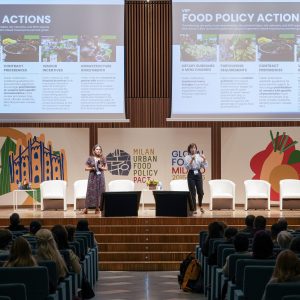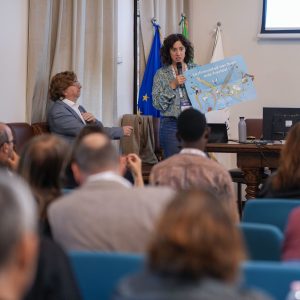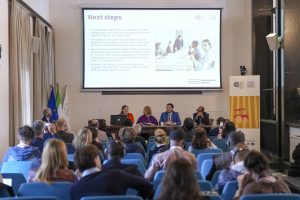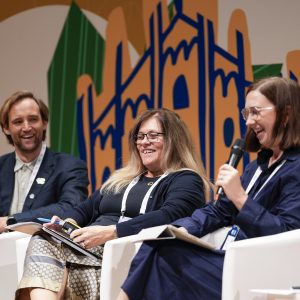
The session School Meals Procurement: Beyond the lunch tray: Building sustainable school food systems, co-organized by ICLEI Europe, the World Resources Institute (WRI), and the School Food for Change project during the 2025 MUFPP Global Forum (University of Milan, 16 October 2025), explored how schools can drive healthier, fairer, and climate-friendly food systems.
The session began with opening remarks on the transformative power of sustainable school meals by the event organisers, followed by two interactive roundtables highlighting city-led innovations and the importance of monitoring impacts to demonstrate how school canteens can promote social inclusion, public health, and sustainability.
The Power of School Meals
“Every school meal is a policy in action,” said Amalia Ochoa (ICLEI Europe), opening the session with a reminder that in Europe alone, over 90 million students eat daily at school. She presented the School Food for Change project as a model of systemic transformation, grounded in three pillars: sustainable procurement, a whole-school approach, and education for planetary health diets. The initiative has already reached 600,000 children, trained 500 canteen staff, and inspired over 111,000 citizens to call for free, healthy meals for every child in Europe. “Small local actions,” Ochoa stressed, “can drive global change when schools become laboratories for sustainability.”
From the World Resources Institute, Edwina Hughes brought the climate dimension into focus through the Cool Food Pledge. The initiative, now joined by 90 members worldwide, has helped organizations cut food-related emissions by up to 40% per meal. “Food must be healthy, sustainable, and delicious,” Hughes noted, “because even the most climate-friendly meal won’t succeed if children don’t want to eat it.” Cities like Ghent and Copenhagen are already using this framework to track results and guide procurement.


Cities Leading the Change
Drawing on the work of SchoolFood4Change, the first panel, hosted by Anastasia Lundqvist (SF4C Project and WWF Sweden), showcased how city-led initiatives are driving meaningful change—from policy shifts to innovative partnerships and procurement models.
In Leuven (Belgium), explained Ellen Vantomme, schools responded to rising child hunger after COVID-19 by introducing breakfast trolleys, fruit-sharing programs, and a pioneering vegetarian catering model that supports local farmers. “It started small,” she said, “but it’s changing national policy.”
In Mbale (Uganda), Wilbur Kakaire described a journey from parent-funded to government-supported school meals. Through school gardens and community engagement, Mbale now aims to reach 80% of pupils, proving that inclusive feeding programs can strengthen both education and resilience.
Estelle Jacq from Lyon (France) showcased how the city turned lunch into a learning moment. A “School Catering Handbook,” co-created with 80 canteen staff, helps children explore new foods, reduce waste, and build social skills at the table. “Mealtime,” Jacq said, “is not just about nutrition—it’s about education and equality.”


Tracking success towards healthy, sustainable school meals
The second panel, hosted by Edwina Hughes, explored how cities can use procurement strategies and data to promote healthy and sustainable food.
From Copenhagen, Betina Bergman Madsen illustrated how procurement—often seen as bureaucratic—can be revolutionary. By embedding sustainability in contracts, the city now serves 88% organic meals and has removed beef and lamb from most menus to lower emissions. She leads the European Food Procurement Officer Network, linking 17 countries to share best practices and align public purchasing with the UN Sustainable Development Goals. “Every tender,” she said, “is a chance to shape the food system we want.”
Meanwhile, Joana Aguiar from Matosinhos (Portugal) described how her city serves 17,000 students with meals grounded in the Mediterranean diet. Through strict procurement standards, community feedback, and continuous nutritional monitoring.
Sarah Bruinaars from Ghent reminded participants that success isn’t just about carbon savings or nutrition data—it’s also about joy. Ghent conducts taste surveys with children, analyzing what they truly like. “We can’t change habits without understanding preferences,” she said. The city’s data-driven yet human-centered strategy has already reduced its food emissions by 38%.


Common Threads and Takeaways
During the session, a common vision emerged: cities are proving that systemic change can start on a plate. By combining procurement, education, and participation, they are making healthy, sustainable food both accessible and appealing. Resources such as School Food for Change’s triple-approach framework and the Cool Food Pledge offer tools to measure progress and inspire others.
As one participant concluded, “School meals are not charity—they’re an investment in our future.” From Leuven’s breakfast trolleys to Copenhagen’s procurement policies and Mbale’s gardens, the message was clear: when food policies align with care, culture, and climate, even the simplest school lunch can nourish the planet.

Special thanks to Gaia Donghi, Mufpp Intern from the University of Milan, for writing this article.