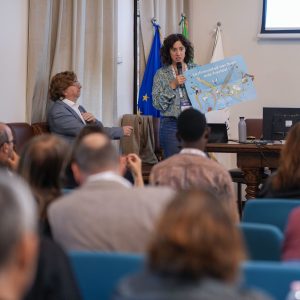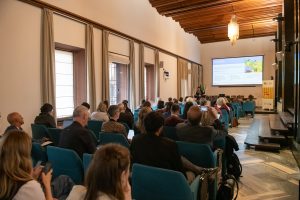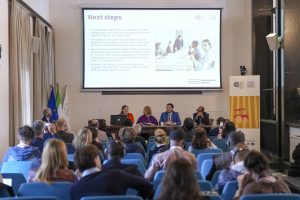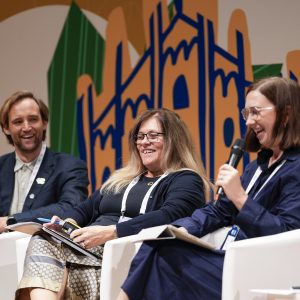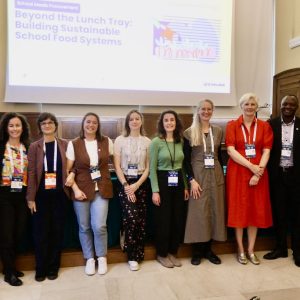
The interactive session Assessing economic, social and environmental impacts of municipal food procurement policies: the role of participatory action research took place during the MUFPP Global Forum 2025 (16 October 2025, University of Milan) and explored cities’ public food procurement policy goals and implementation strategies, with a specific focus on understanding impacts and trade-offs through participatory action research.
The event was organised by Cornell University and the City Food Policy Project, in collaboration with key research and policy partners. The session was hosted by Becca Jablonski (Cornell University) and Juliana Tângari (Comida do Amanhã Institute) who provided and introduction and set the framing for the discussion.
Building on this introduction, the session examined how cities around the world are using values-based public food procurement as a strategic policy tool to transform food systems. Moving beyond traditional procurement approaches focused solely on food provision, the discussion highlighted how public food procurement can advance broader economic, social, health, and environmental objectives. These include strengthening local economies, supporting family farmers, improving nutrition, and reducing greenhouse gas emissions across multiple settings, such as schools, hospitals, and social assistance programs.
Participants were introduced to the concept of values-based procurement, with an emphasis on how implementation strategies may be similar across cities while underlying values and policy priorities differ according to local contexts. Examples from Brazil and the United States illustrated how cities prioritize distinct values—such as support for family farmers or compliance with multi-criteria “good food” standards—while adapting procurement mechanisms accordingly.
The introduction also presented the City Food Policy Project, launched in 2017, which aims to support cities in better understanding the trade-offs and co-benefits associated with different procurement choices. The project adopts a participatory and innovative approach by directly involving stakeholders in the co-creation of research design and by combining data, modelling, and stakeholder knowledge to analyse how policies influence decision-making across food supply chains.
A key message was that procurement policies are never implemented in isolation. Cities complement procurement strategies with guidelines, incentives, technical assistance, infrastructure investments, and other supportive measures to ensure coherence between policy goals and outcomes. Understanding how different stakeholders respond to these combined strategies was identified as essential for achieving intended impacts.
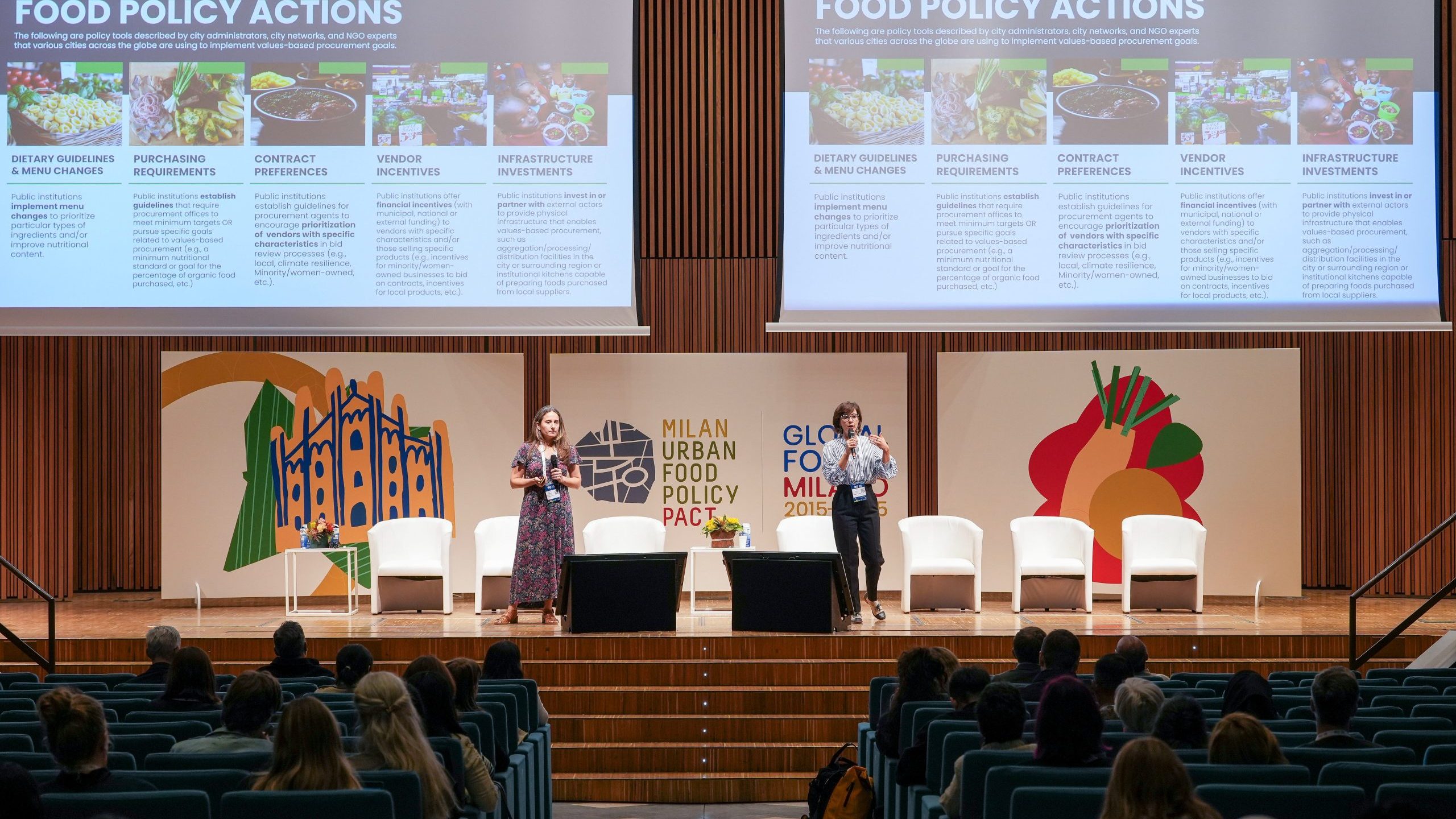


Group discussions
The second part of the session was dedicated to group discussions. Participants were divided into breakout groups, supported by a slide outlining group assignments and guiding questions. Discussions focused on two main issues:
(1) identifying stakeholders who may be directly or indirectly affected by municipal food procurement policies, and (2) exploring the types of knowledge, data, and research needed to assess whether proposed policies and implementation strategies are achieving their intended outcomes.
The exchange was enriched by the participation of city officials and policy leaders from multiple regions. Participants included Felipe Thiago de Jesus, Director of Food Systems for the City of Curitiba (Brazil); Claudia Sónia Roldão, Councilor of the Department of Economic Activities and Markets for the City of Pemba (Mozambique); Dedie Abdu Rachim, Mayor of Bogor, and Rudy Mashudi, Head of the Regional Development Planning, Research, and Innovation Agency (Bapperida), City of Bogor (Indonesia); Gilles Perole, Deputy Mayor of Mouans-Sartoux (France); Davide Arcadipane, Chief of Staff of the Food Policy Alderman, City of Liège (Belgium); Taylor LaFave, Chief of Food Policy and Planning, City of Baltimore (USA); Sarah Newton, Public Health Service Lead for the City of Birmingham (United Kingdom); Jacques Justo Alcoba Barba, Secretary of Human Development, City of La Paz (Bolivia); and Darklane Rodrigues, Secretary of Food Security for the City of Belo Horizonte (Brazil). Their contributions brought diverse institutional perspectives and enriched the discussion with concrete policy and implementation experiences.
Town Hall feedback and key insights
During the final plenary discussion, participants shared key reflections emerging from the group work. One example highlighted the experience of Curitiba, which uses an inter-municipal consortium (Pró-Metrópole) to support farmers in surrounding municipalities, enabling them to supply food to the city’s urban markets. This case underscored the importance of considering stakeholders beyond administrative boundaries and recognizing that actors respond to policies based on multiple motivations, not solely financial incentives. Identifying who is included in policy dialogues was therefore emphasized as a critical factor in ensuring that procurement policies achieve their intended values.
Another key insight emerged from the discussion on knowledge and data needs. Participants noted that while some cities, such as Leeds, have access to extensive data across social, economic, and environmental dimensions, a major challenge lies in integrating these datasets across sectors. Fragmented data systems can limit cities’ ability to assess trade-offs, co-benefits, and overall policy effectiveness.
Overall, the discussion reinforced the need for tools and approaches that support intersectoral data integration, enabling cities to more effectively evaluate impacts and scale up values-based food procurement policies.
Special thanks to Younes El Ouafiq, MUFPP Intern from the University of Milan, for writing this article.