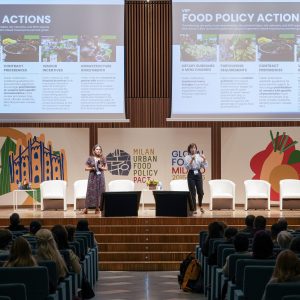
As part of the MUFPP Global Forum 2025, the session Good Food for Healthy Cities: How Your City Can Work with Business to Deliver a Climate-Friendly Food Sector (15 October 2025, University of Milan) explored how cities and businesses can join forces to build climate-friendly, equitable food systems.
Organized by C40 Cities and the Laudes Foundation, the session showcased experiences from New York (United States), São Paulo (Brazil), London (United Kingdom), and Austin (United States), demonstrating how cooperation between the public and private sectors is key to promoting healthier diets, reducing emissions, and strengthening resilient local economies.
The session was structured into three main parts: opening remarks and keynotes, presentations of two C40 resources focused on business engagement, and a panel discussion featuring city officials sharing practical examples and lessons learned.
The Keynotes: Nico Muzi from Madre Brava and Annelies Withofs from the Laudes Foundation
Nico Muzi Co-Founder and Chief Programmes Officer of Madre Brava, highlighted the crucial role of cities in tackling both climate change and public health through food. He noted that even with full fossil fuel transition, current diets could push global temperatures above 1.5°C, while unhealthy diets drive obesity, diabetes, and cardiovascular diseases. Cities can leverage their influence over food systems, particularly supermarkets and retailers, to promote the Planetary Health Diet, emphasizing plant-based foods and reduced meat, dairy, sugar, and salt. Muzi outlined three key actions for city leaders: convene stakeholders across the supply chain to understand challenges and identify ways cities can support transformation, persuade retailers to adopt sustainable targets aligned with the Planetary Health Diet, and use public procurement and city policies to make healthy and sustainable food the default choice for citizens.
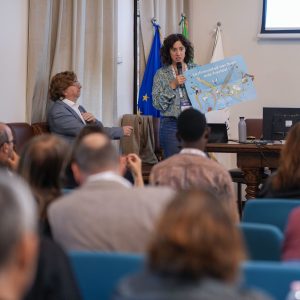
Annelies Withofs, Head of the Food Programme at the Dutch philanthropy Laudes Foundation highlighted the Foundation’s work to drive a just transition in food, alongside built environment, finance, and fashion. Focusing on cities, she noted that food is both a major driver of emissions and social inequities and a source of solutions. Withofs outlined four key elements for urban impact: scientific data to guide policies, connections and experiential learning that allow cities to share insights, citizen engagement to ensure inclusive and resilient planning, and collaboration with the private sector to incentivize innovation. She called this the “secret sauce” for food system transformation, showing how cities and businesses can form “unlikely alliances” to shift diets, reduce environmental impacts, and strengthen local supply chains.

Findings from the “Good Food for Healthy Cities” Guide
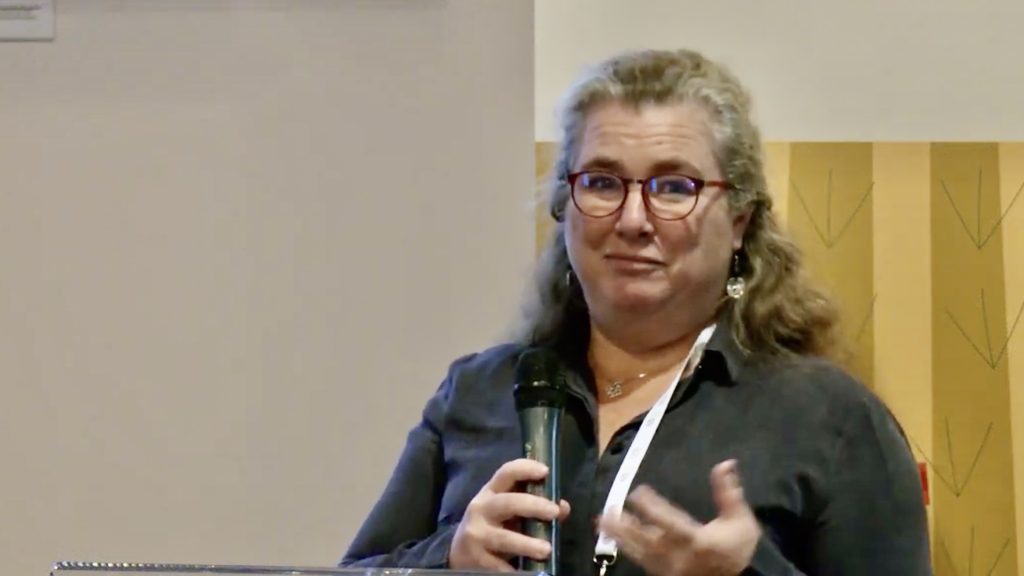
Stefania Amato, Head of Food Strategy at C40 Cities, presented key findings from the Good Food for Healthy Cities guide, developed to support cities in engaging businesses to accelerate the transition toward healthier and more sustainable urban food systems. The research highlights that while cities have significant leverage through public procurement and local programmes, over 80% of the food consumed in cities is supplied by the private sector, making collaboration with businesses essential for systemic change.
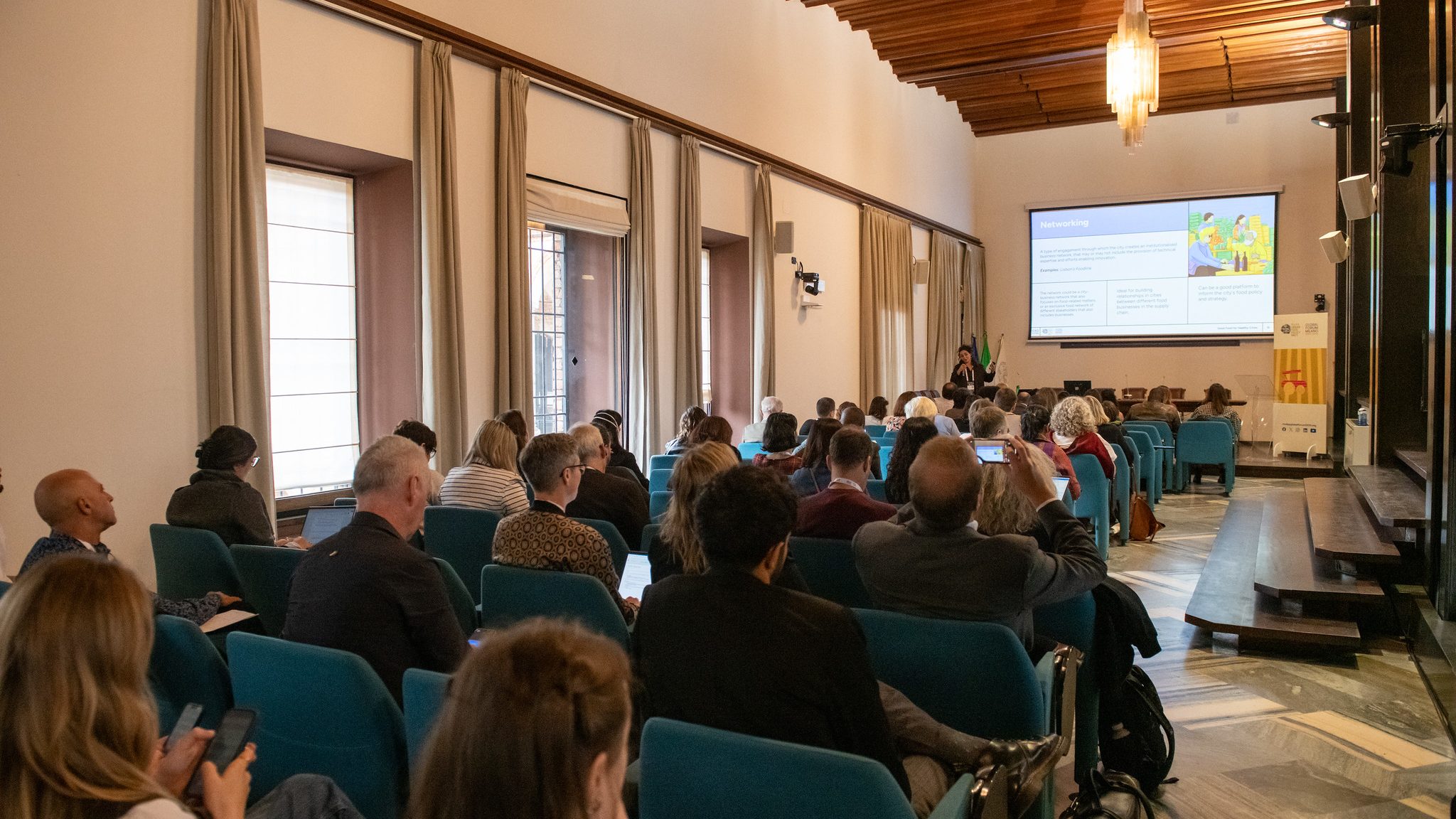
Drawing on C40’s experience across multiple sectors, the guide shows that coordinated city–business engagement can substantially amplify climate outcomes. It identifies several models already being implemented by cities, including business support programmes for small food enterprises, innovation labs to co-develop solutions, supply-chain networking to strengthen local markets, convening platforms that bring large companies into shared climate and health agendas, and leadership-driven “call to action” approaches where cities lead by example. Together, these models demonstrate how cities can use their political capital, convening power, and policy tools to influence food environments beyond public procurement and drive large-scale dietary and emissions shifts.
Findings from “Quantifying the impact of city–business alliances on food system GHG emissions and public health”
Researchers Shambhavi Gupta and Rashi Sharma (Svarascape) presented early findings from a joint study with C40, namely Quantifying the impact of city-business alliances on food system GHG emissions and public health. Using New York City as a pilot case, the research models how shifts from animal-based to plant-based protein across restaurants, retailers, and food service companies could reduce greenhouse gas emissions and improve public health outcomes. The analysis combines quantitative scenario modelling with qualitative insights from city officials and businesses, testing different levels of private-sector participation and menu shifts.
Results show that ambitious collaboration delivers transformative outcomes: high engagement scenarios—where most businesses participate and menus shift significantly—could reduce food-related emissions by up to 40–45% by 2030, while limited, voluntary action produces only marginal gains. The study highlights that change unfolds through gradual consumer adoption, reinforced by pricing, availability, and default options. Overall, the findings demonstrate that coordinated city leadership, combined with strong business participation, can normalise healthier, lower-emission food choices at scale, turning dietary change into a powerful lever for climate action and public health.

Examples of innovation from global cities
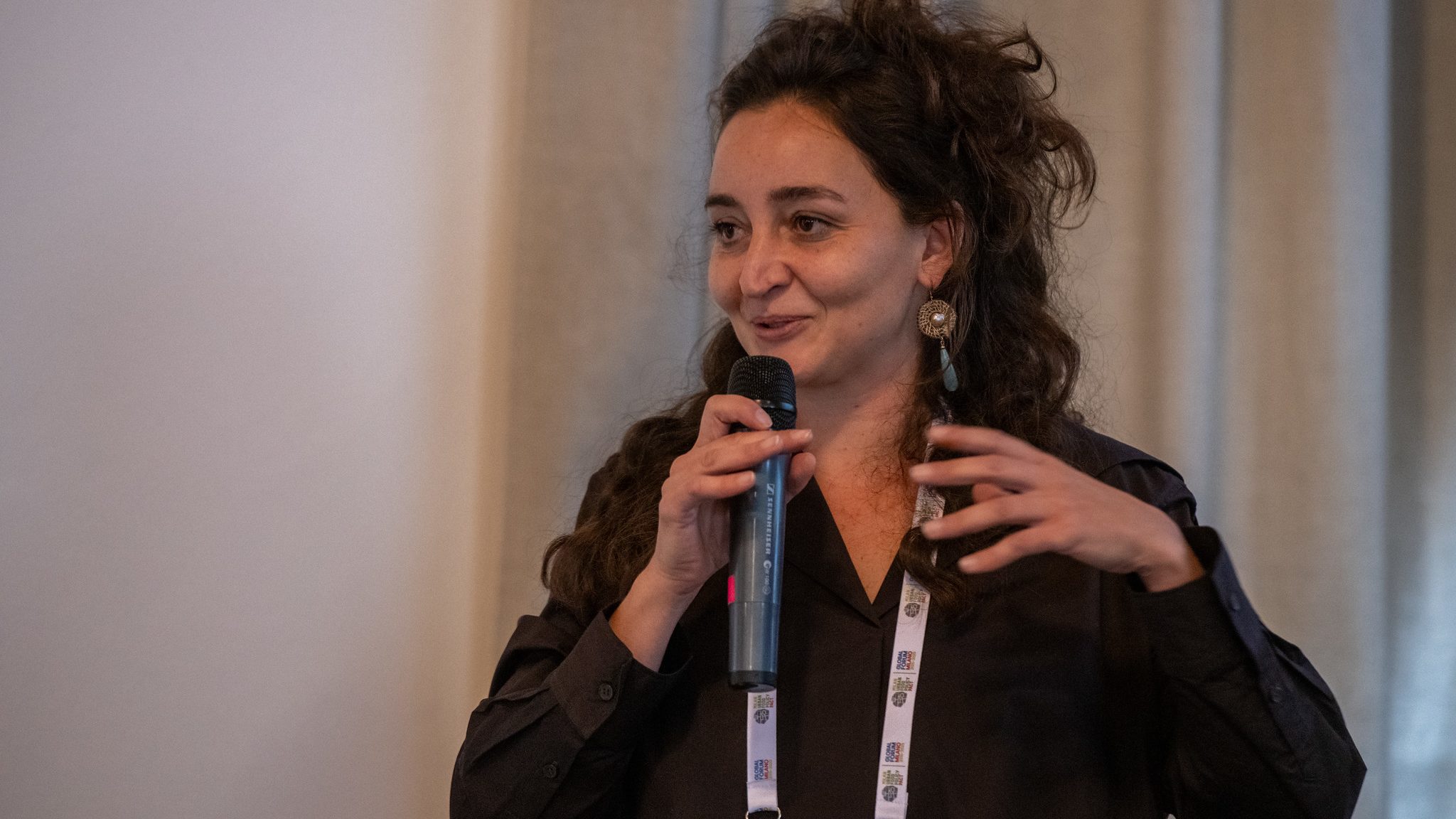
As part of the third part of the session, the floor went to city officials illustrating how collaboration between governments and companies can produce tangible results. Contributions followed from Lauren Drumol (New York City), Edwin Marty (Austin), and Katie Rowberry (ReLondon).
Lauren Drumol, Policy Advisor at Mayor’s Office of Food Policy, from New York City outlined how the city combines public leadership with private-sector engagement to reduce food-related emissions while improving access to healthy food. While municipal food procurement aims to cut emissions from city food purchases by 33% by 2030, this represents only a small share of overall consumption. To address this, New York launched the Plant-Powered Carbon Challenge, engaging private institutions—from universities to hospitals and sports venues—to reduce their food-related emissions by at least 25% by 2030 through plant-forward menus and behavioral nudges. Drumol also highlighted the city’s Shop Healthy program, which works with corner stores in underserved neighborhoods to increase access to fresh, nutritious foods through technical assistance, improved product placement, and community-based outreach.
Katie Rowberry of ReLondon illustrated London’s journey from convening businesses to driving concrete action on reducing food-related consumption-based emissions. ReLondon, a partnership between the Mayor of London and the city’s boroughs, initially brought together major food retailers, hospitality chains, and local actors to build shared commitments on food waste reduction and dietary shifts. Building on this momentum, subsequent research and place-based pilots revealed that while large companies face structural barriers beyond city control, small and medium-sized local businesses can act more quickly. By reshaping everyday food choices at neighbourhood level, these actors can catalyse broader system change and influence larger players, highlighting the power of hyper-local action in accelerating city-wide food transitions.
Edwin Marty from the City of Austin highlighted how food system transformation can advance even in politically and culturally challenging contexts. Operating in a conservative state with limited municipal control over food procurement, Austin embedded food into its broader climate strategy by developing a comprehensive Food System Plan grounded in strong community mandate. The plan, shaped through extensive public engagement, addresses food-related emissions, food insecurity, and resilience through 61 strategies, including climate-smart and plant-based diets. By reframing sustainability around choice, freedom, and incentives, Austin is engaging private-sector partners to expand plant-based options in restaurants, demonstrating how narrative, culture, and local leadership can unlock climate action in diverse urban contexts.
Throughout the session, speakers emphasised that successful partnerships depend on shared metrics, transparency, and trust. By aligning public procurement with business innovation, cities can create new markets for sustainable products, while companies can scale up low-carbon, nutritious food offers. Participants agreed that collaboration works best when underpinned by long-term governance structures and a commitment to inclusion.



Conclusion – Food as a bridge for people and planet
The session underscored that neither cities nor businesses can transform food systems alone. Only through sustained collaboration can they drive climate action, improve diets, and strengthen local economies. The Good Food for Healthy Cities agenda signals a new phase in urban food policy, where public–private cooperation moves beyond voluntary action to become a structural driver of change—making healthy, affordable, and low-carbon food the default choice for all.
Special thanks to Younes El Ouafiq, MUFPP Intern from the University of Milan, for writing this article.